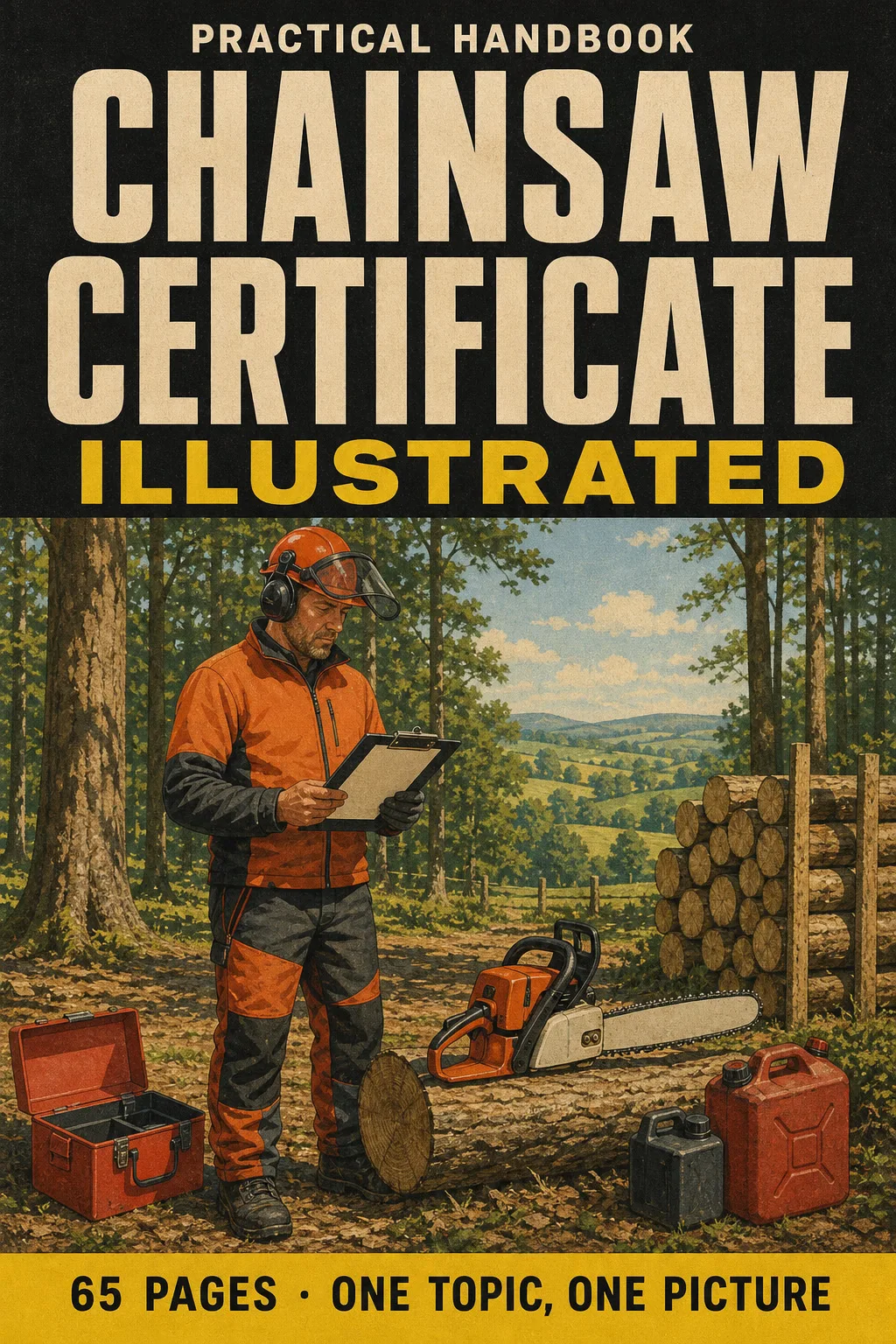
📄 Digital book in PDF · read it on your phone or print it
Pre-use checks, chain tension, the chain brake test, sharpening in millimetres and degrees, kickback, compression and tension cuts, and the emergency plan. Every topic has its own page: the drawing first, then what you need to remember. 65 illustrated pages.
🔒 Secure checkout · PDF by email · 30-day guarantee
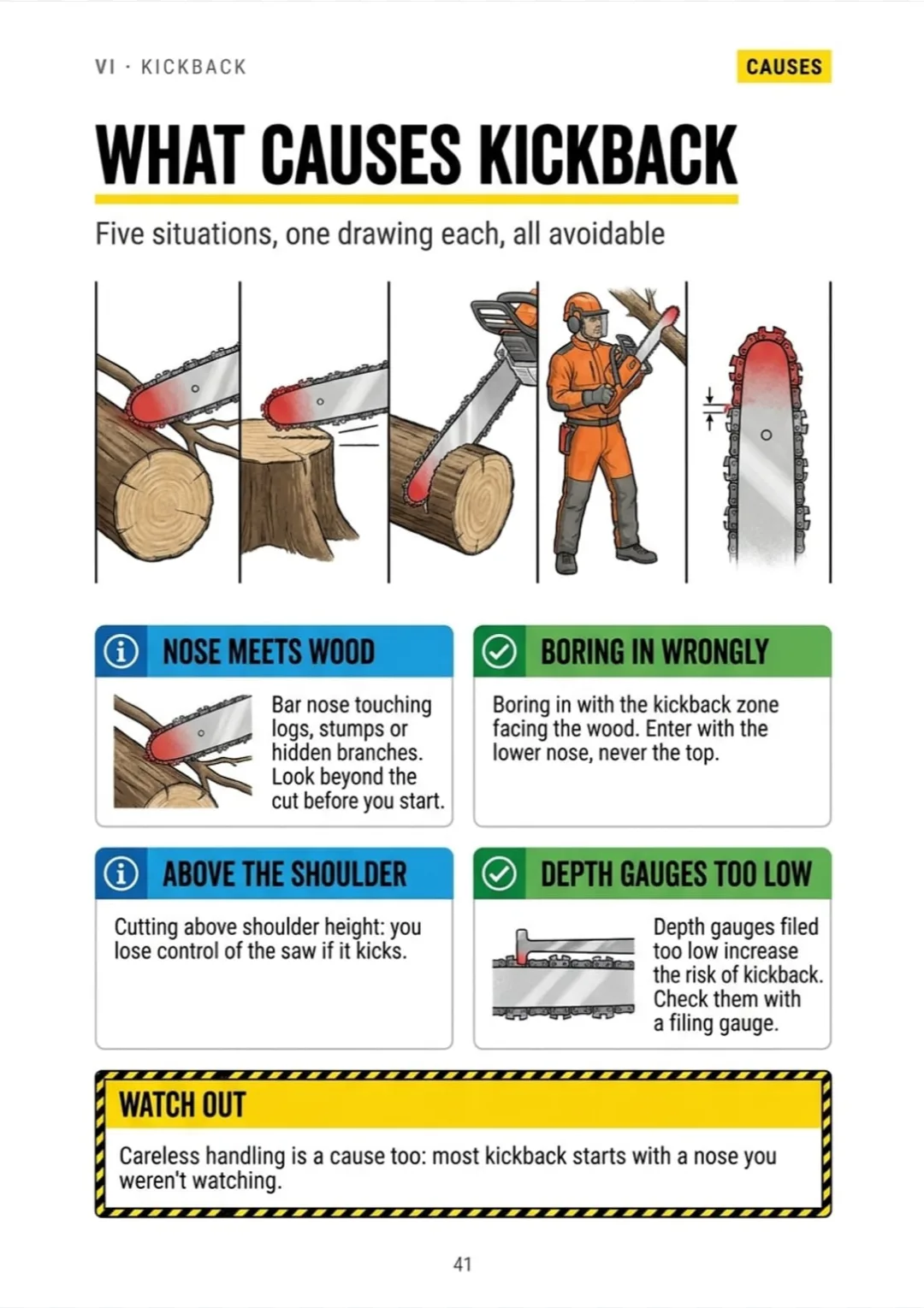
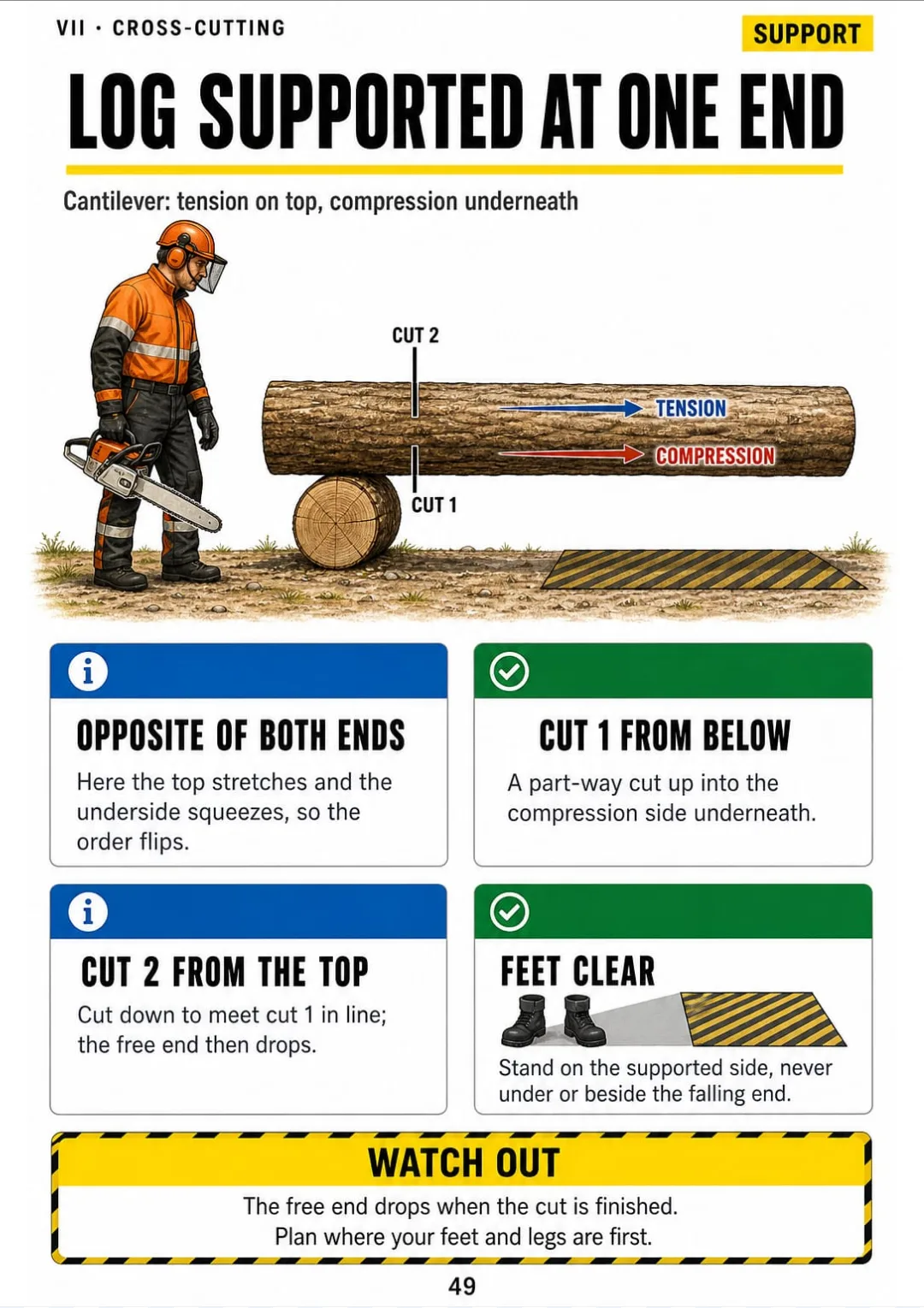
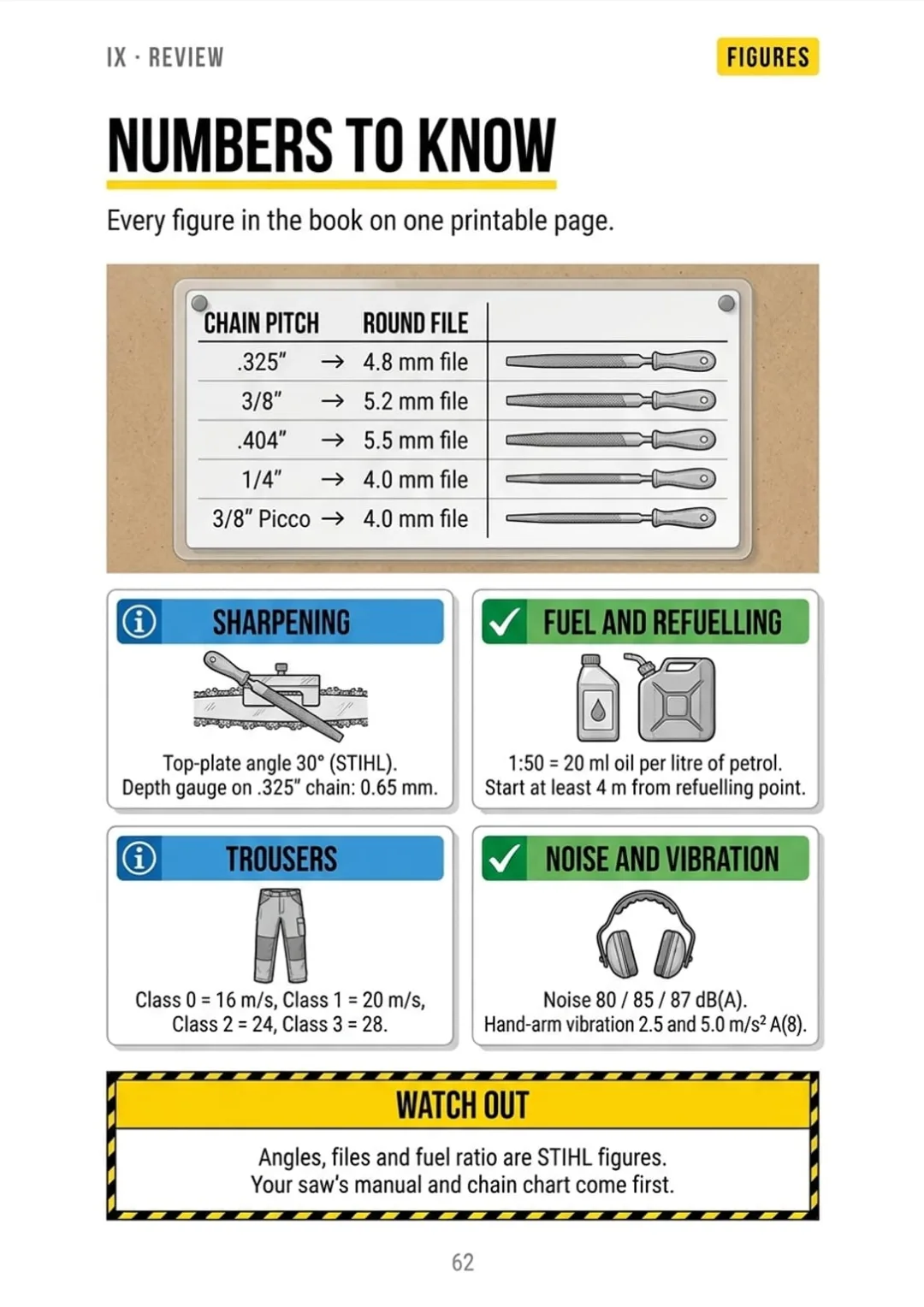
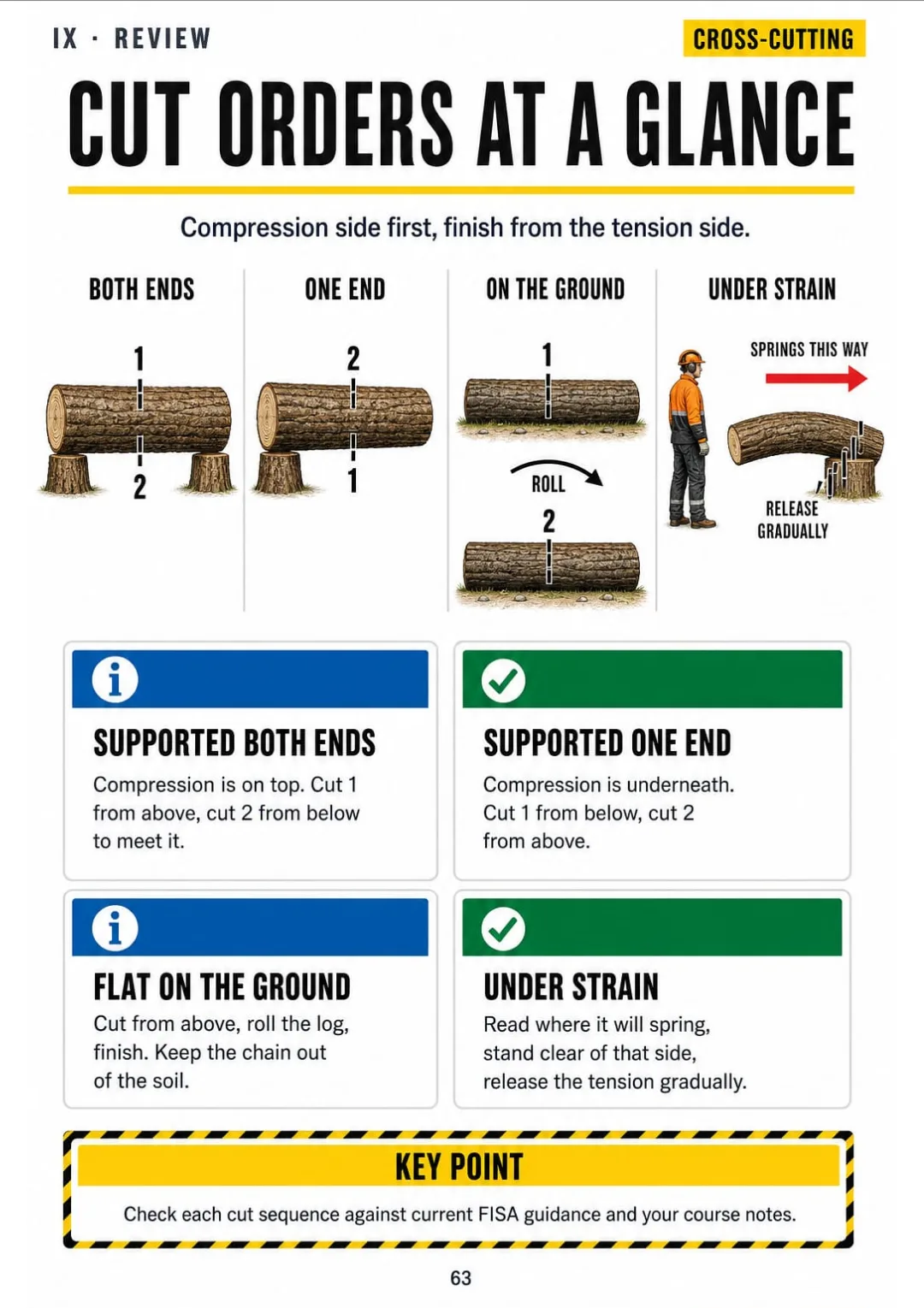
Every page has a large drawing and a box with the measurements, steps and cut orders you need to know:


Swipe to see more →
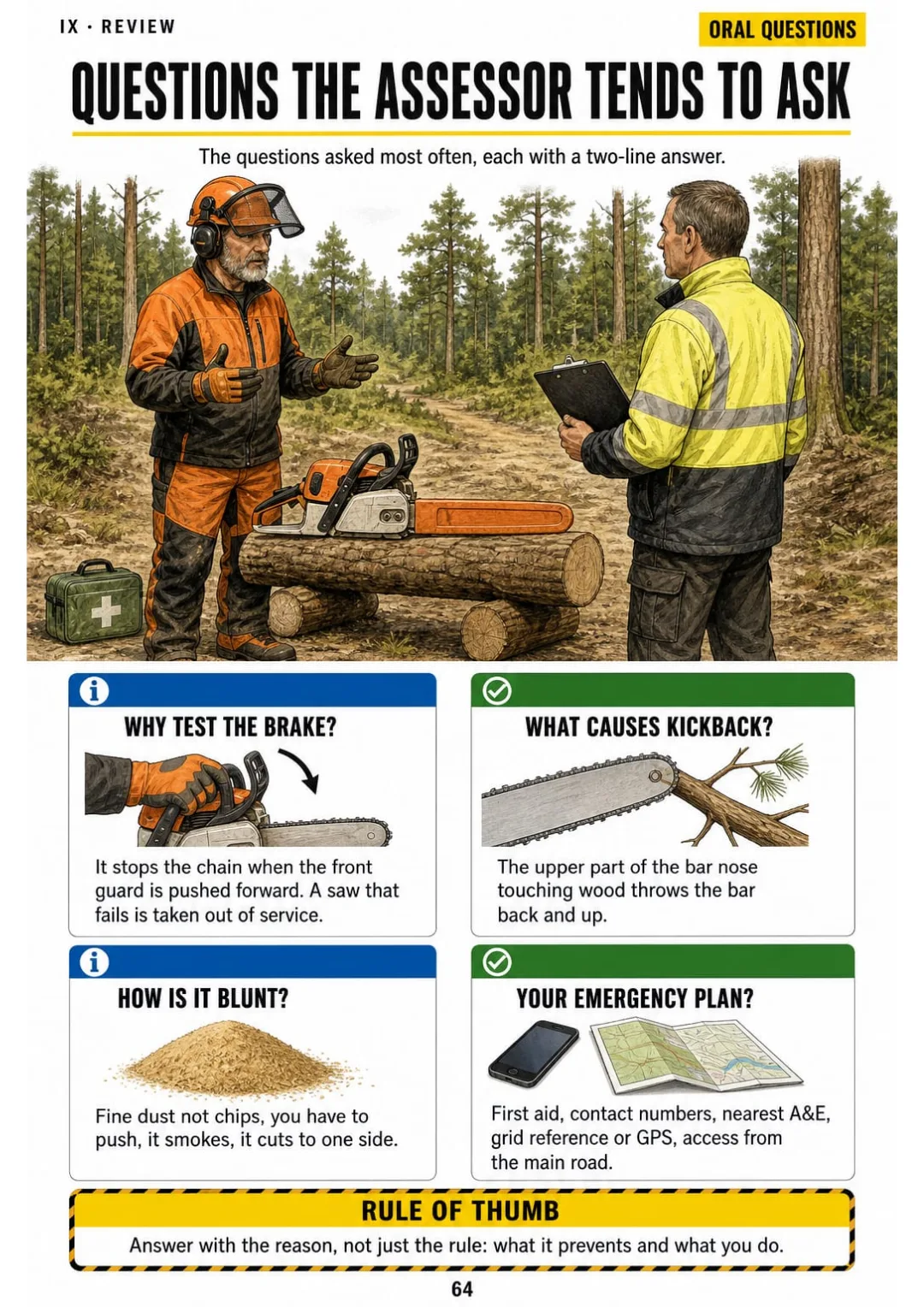
These are real pages from the book. The table of contents is the full one: 9 parts and 61 topics.
You're at the bench with the saw switched off, a .325" chain in front of you and a file in your hand. And you can't remember which file size goes with it.
On the course the instructor showed you once, saw in hand. The manual puts it in one long paragraph: pitch, file diameter, angles, depth gauge. Words don't show your hand where the file goes.

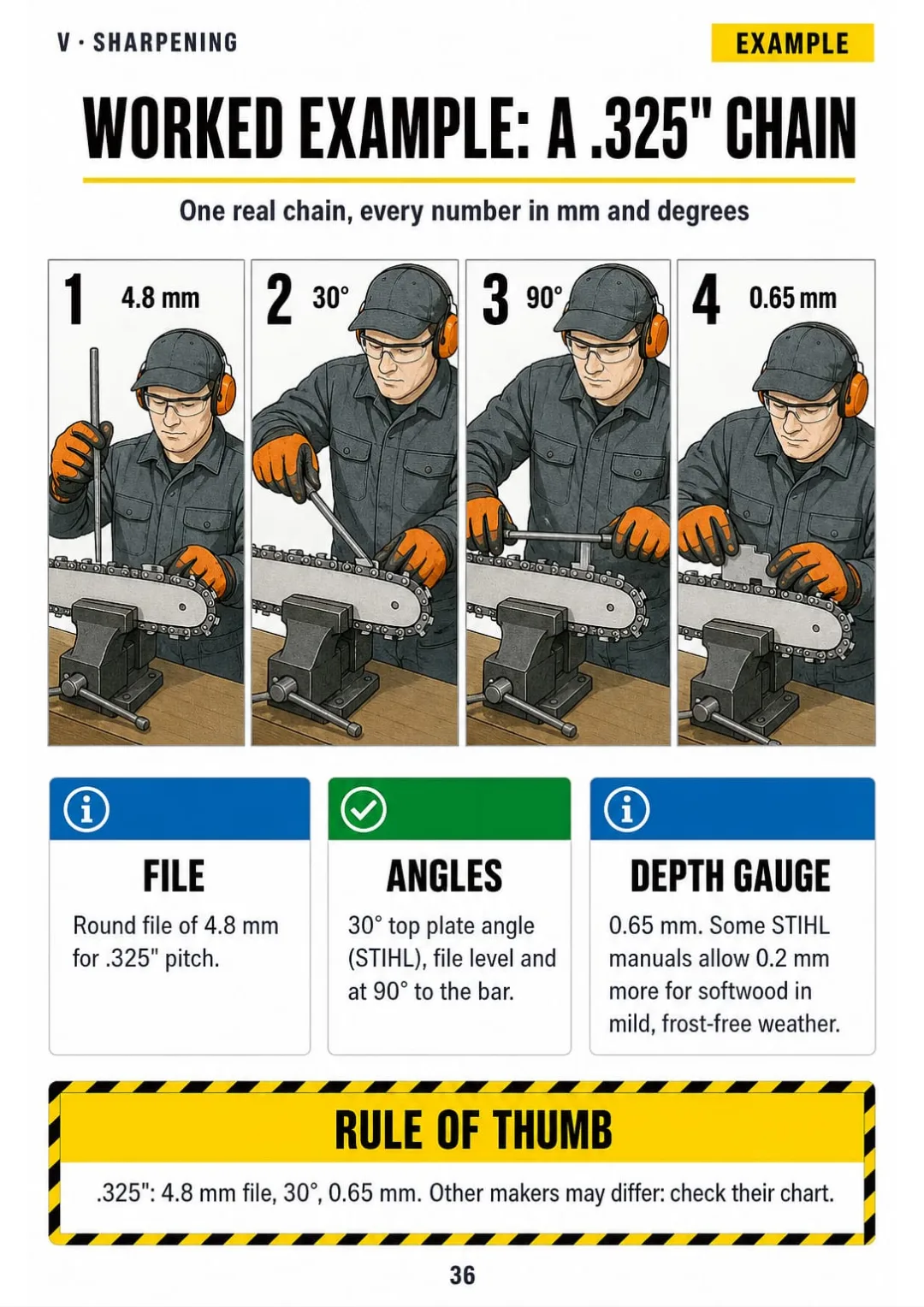
In the book, that chain is one page: the cutter drawn from above with the file at 30°, held at 90° to the bar, the 4.8 mm file named in a box and the depth gauge set at 0.65 mm. A worked example you can follow cutter by cutter.
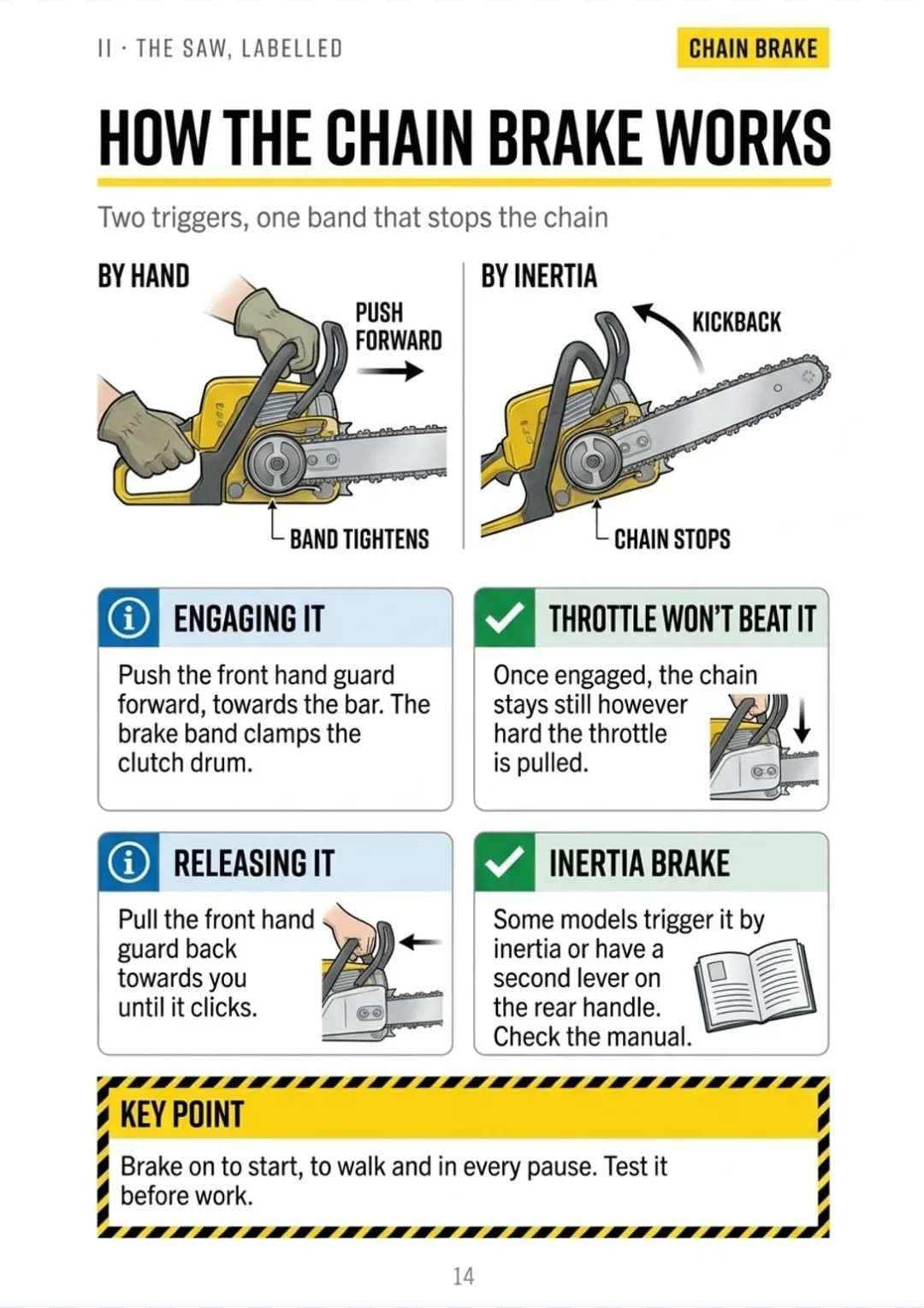
The same goes for chain tension, the chain brake test, the kickback zone and the cut order on a log under tension: each one has its own page.
You see it, you understand it, and next time you sharpen without going back to the manual. And when the assessor asks, you can say it out loud.

Before you touch the saw, the saw labelled, daily and weekly checks, fuel and starting, sharpening and bar care, kickback, cross-cutting, the site and emergency plan, and a final review: 65 pages, all illustrated
Think of it this way:
The assessor hands you the saw, engine off, and says: "Talk me through your pre-use check." Eight things, and he wants them in order.
In the book you open the pre-use check page and see the saw drawn from the side, plug lead off, numbered from 1 at the front hand guard to 8 at the silencer. You just follow the numbers round the saw.

The same with chain tension, the chain brake test, sharpening a .325" chain, the kickback zone and a log supported at one end: each one on its own page.
Chainsaw Certificate Illustrated is 9 parts and 61 topics, all drawn, and it ends with the numbers to know, the cut orders at a glance and the questions assessors tend to ask.
What you see drawn, you don't have to memorize.
What the assessment looks like, the law on one page, PPE from head to toe, how chainsaw trousers stop a chain, the labels on boots, gloves and visor, noise, vibration and your fitness on the day
The saw with every part named, the seven safety features, how the chain brake works, the anatomy of a cutter, pitch and gauge, and the bar, sprocket and clutch
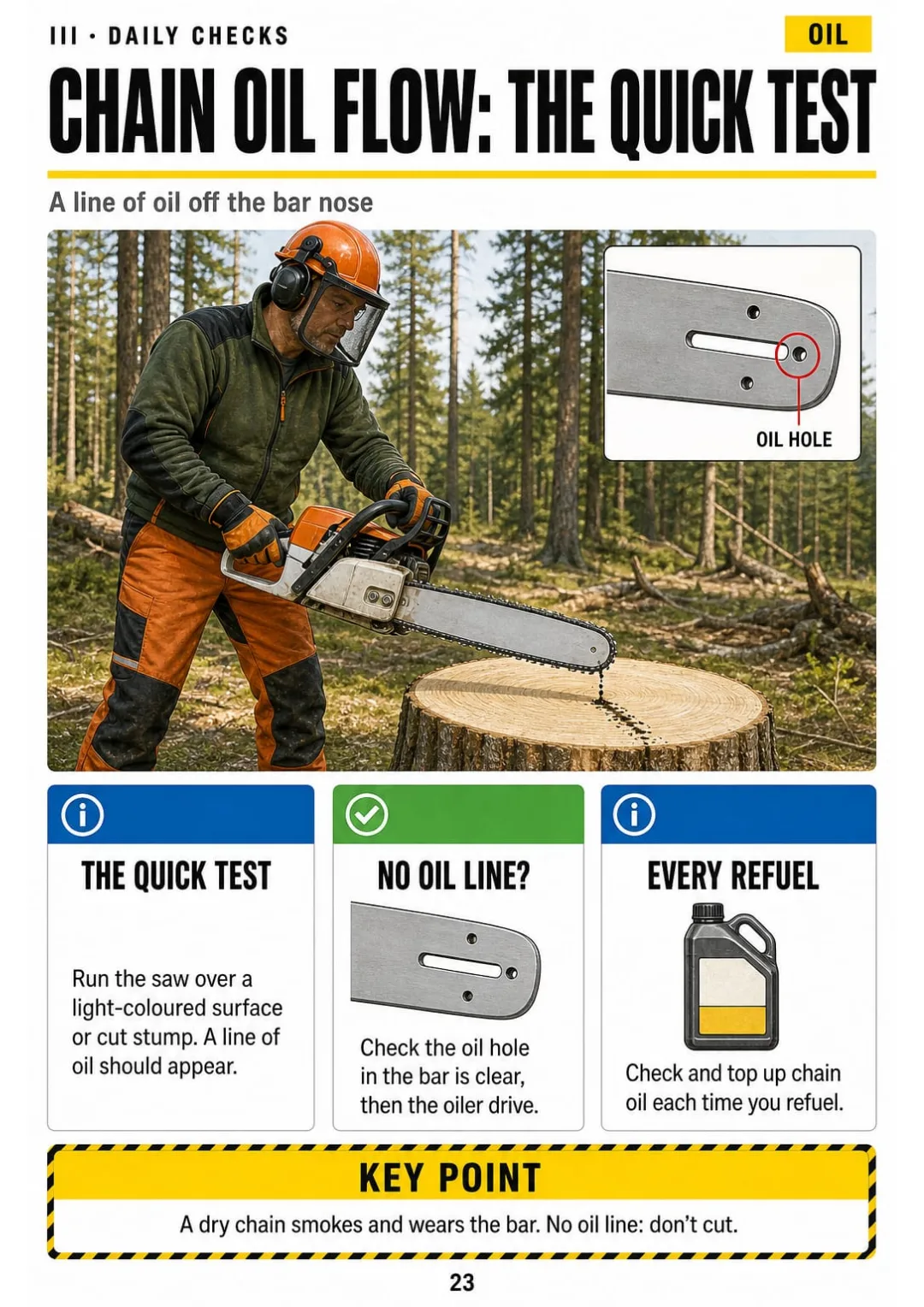
The pre-use check always in the same order, chain tension cold and warm, testing the chain brake, throttle, lockout and stop switch, idle speed, oil flow, weekly maintenance and what to do with a fault: the part you'll talk the assessor through, step by step, without skipping one
Mixing fuel, refuelling safely, the ground start, the leg-lock start and why drop-starting is wrong, carrying and transport
Signs of a blunt chain, choosing the file, top plate and vertical angles, sharpening step by step, depth gauges, a worked .325" example, why a chain cuts crooked, bar care and when to replace the chain
The kickback zone, what causes it and how to reduce the risk, pulling and pushing chain, stance and the danger zone around you
Reading compression and tension, the golden rule of cut order, logs supported at both ends, at one end or lying flat, small wood, the bore cut, stacked timber, a pinched bar and cutting to length: so you know which side will close before the bar goes in
Site risk assessment in 5 steps, the emergency plan, the first aid kit and large wound dressing, lone working and finishing the job
The checks to say aloud, the numbers to know, cut orders at a glance, questions assessors tend to ask and the most frequent mistakes
At the end of the book: A final review with the checks to say aloud, the numbers to know, cut orders at a glance and the questions assessors tend to ask.
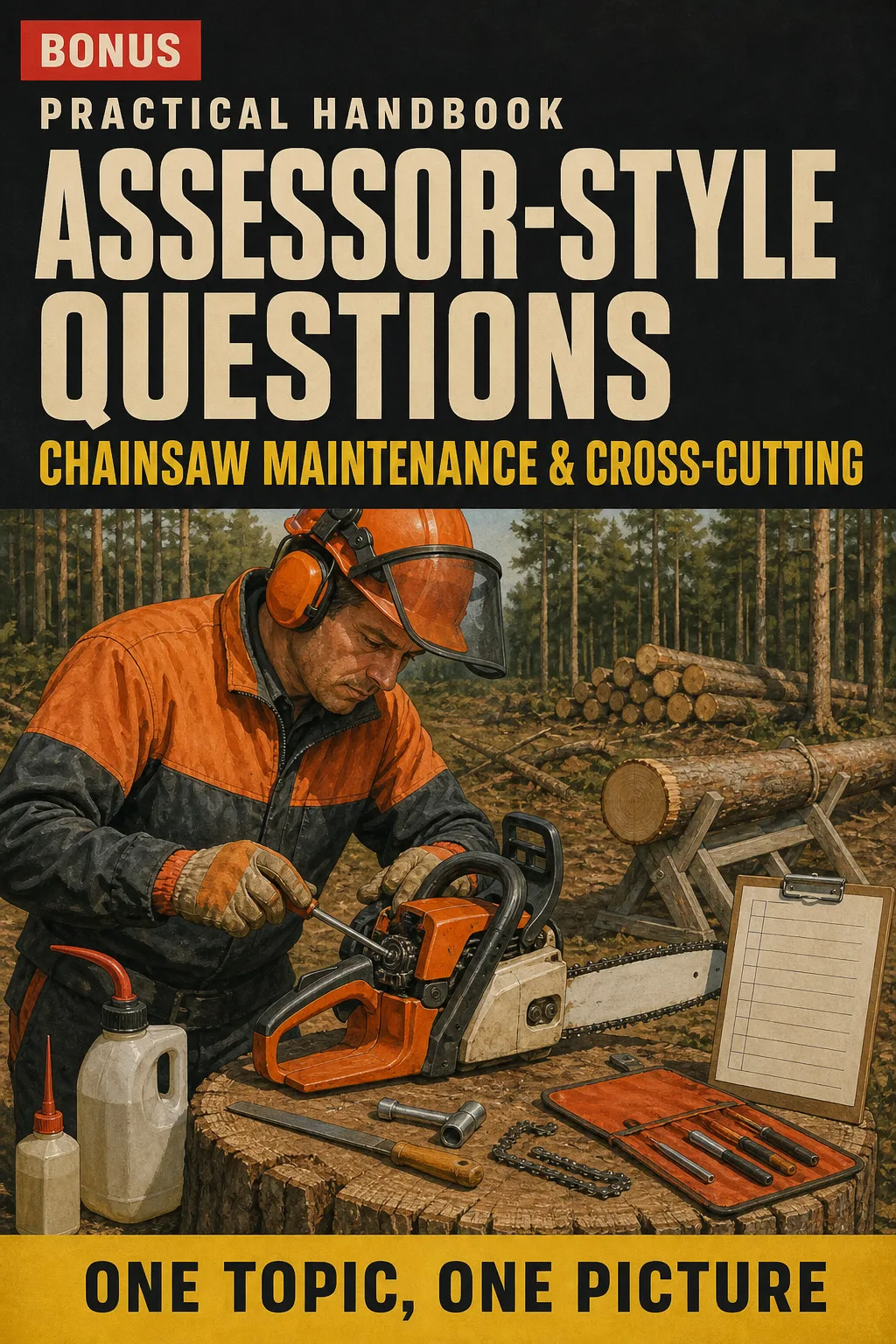
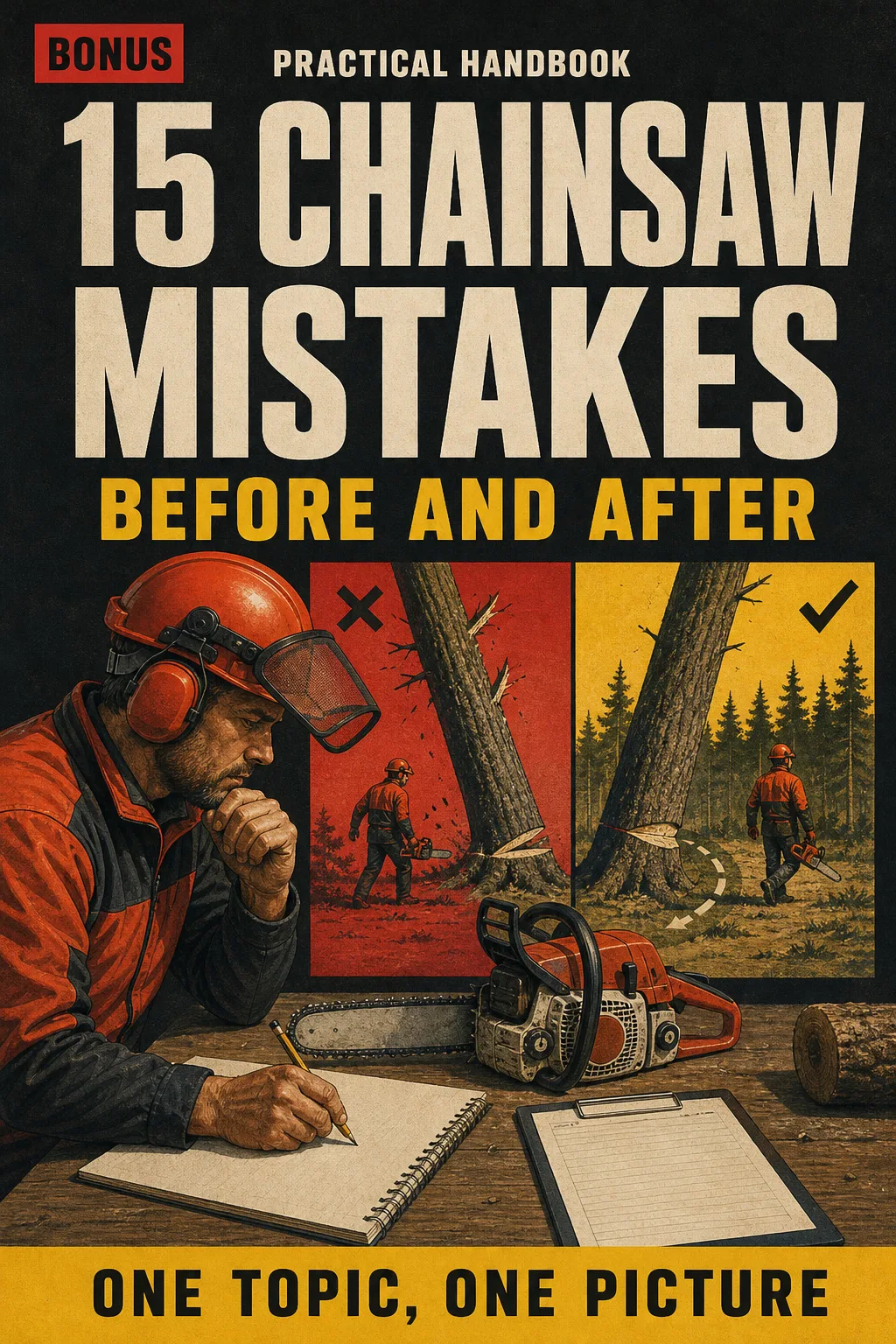
Practise the questions an assessor tends to ask, out loud, with a short answer for each, so the words are there when you need them.

See the most frequent mistakes drawn side by side with the right way, from a slack chain to the wrong cut order on a log under tension.
📄 This is a digital PDF book sent to your email: nothing is printed or shipped.
PDF by email: We email you Chainsaw Certificate Illustrated as a PDF, together with the two free books. It's a single payment: no installments, no extra charges.
Read the matching page the evening after each training day, and what the instructor showed you with the saw stays in order.
Go over the checks to say aloud, the numbers to know and the cut orders at a glance, then practise the assessor-style questions out loud.
Print the pages you use most and keep them in the van: sharpening, chain tension and the cut order, at a glance.
📄 This is a digital PDF book sent to your email: nothing is printed or shipped.
Try Chainsaw Certificate Illustrated for 30 days, bonus books included.
We refund everything if the file won't open, if the book isn't what you see here, if you were charged twice or if the email doesn't arrive. Just email us.
You pay once. No subscriptions.
Yes, that's who it's written for. It follows the topics of the entry-level chainsaw maintenance and cross-cutting unit in the UK, whether your course is with City & Guilds/NPTC or Lantra Awards. Everything is in millimetres and degrees. The only inch figure is the chain pitch (.325", 3/8"), because that's how it's stamped on the chain and the box in the UK too. It starts from the saw labelled, so it works if you're new to the saw. If you already use one, go straight to sharpening, the cut orders and the final review.
It's checked against HSE guidance on chainsaws at work, PUWER 1998, the FISA safety guides, the Noise and Vibration at Work Regulations 2005 and the saw and chain manufacturers' specifications. Always follow the manual for your own saw.
No. It's an independent study guide, not affiliated with or endorsed by any awarding body: not City & Guilds, NPTC, Lantra Awards or HSE.
No. You only use a chainsaw after face-to-face training, and the certificate comes only from the practical assessment with an assessor. The book doesn't give you a certificate. It's for going over at home, in the same order, what you did on the course with the saw in your hands, so the checks, the file sizes and the cut orders are fresh when the assessor asks.
No. They're written for this book, in the style an assessor tends to ask, so you can practise answering out loud.
The book and the 2 gift books arrive as a PDF by email, at the address you enter when you pay.
No. It's a one-off payment, with no subscription.
Yes, print it. The pages are made for A4, so you can keep the ones you need in the van or the workshop.
You have 30 days. We refund everything if the file won't open, if the book isn't what you see on this page, if you were charged twice or if the email doesn't arrive: just email us.
No more rereading course notes that don't stick.
The cut order on a log under tension: you see it drawn and that's it.
You arrive at the assessment knowing where everything is.
Drawings make studying faster.
The book is right below.
One-time payment: US$ 27 · Guarantee: 30 days · PDF by email
YES, I WANT CHAINSAW CERTIFICATE ILLUSTRATED FOR US$ 27📄 This is a digital PDF book sent to your email: nothing is printed or shipped.